 EN
Etsy SEO Optimization 2026: Improve Listings & Boost Sales

Do you want to improve your Etsy SEO optimization in 2026 for getting your products noticed? You need a clear understanding of your target market, relevant keyword research, well-optimized listings, compelling product photos, and ongoing performance analysis. This guide explains how to optimize your Etsy listings for search, attract the right shoppers, and build a stronger foundation for long-term sales growth.
Table of Contents
What Is Etsy SEO?
Etsy SEO (search engine optimization) is the process of optimizing your Etsy shop and product listings to help shoppers discover your products through Etsy search.
When a shopper enters a query, Etsy first identifies listings that match the search and then ranks those results based on multiple factors. According to Etsy's Seller Handbook, its search system considers listing information such as titles, tags, attributes, descriptions, and the first photo when matching products with shoppers' queries. Ranking also takes additional listing and shop signals into account.
For example, imagine you sell personalized ceramic mugs. A listing optimized only for the broad term "mug" may struggle to reach shoppers looking for a specific gift. More descriptive phrases such as "personalized ceramic mug" or "custom coffee mug for mom" can help communicate the product's features and intended audience.
Etsy SEO optimization generally involves three connected activities:
Keyword research: Understanding what potential customers search for and which terms are relevant to your products.
Listing optimization: Improving titles, tags, categories, attributes, descriptions, and photos to communicate product relevance.
Performance analysis: Reviewing traffic and sales data to identify what works and where improvements are needed.
SEO can not guarantee a particular ranking or sales volume. Its purpose is to make your products easier to discover while giving shoppers the information they need to make purchasing decisions.

Why Etsy SEO Matters for Selling?
Etsy SEO matters because visibility is an important step in the buying process. Shoppers need to discover a product before they can click on it, evaluate its value, or make a purchase.
A well-optimized listing can help your product match more relevant searches. However, appearing in search results is only the beginning. Your product photos, price, description, reviews, and overall offer also influence whether shoppers decide to click and buy.
Consider three common situations:
- Low search visibility: Your listing may target terms that are too broad, use insufficiently descriptive keywords, or fail to communicate important product attributes.
- High visibility but few clicks: Your title or first photo may not clearly distinguish your product from competing listings.
- Traffic without sales: Shoppers may be finding your listing, but the price, product presentation, shipping details, or other information may not meet their expectations.
Etsy SEO also supports a more sustainable approach to attracting customers. Instead of relying entirely on paid advertising or external social media traffic, you can improve your chances of reaching shoppers who are already searching for products like yours.
The goal is not only to attract the largest possible audience, but also to connect your products with shoppers whose needs, preferences, and purchase intentions align with what you sell.
How to Optimize Your Etsy Listings for Search?
A successful Etsy SEO strategy starts with understanding your market and optimizing your listings to match what shoppers are searching for. The following six steps provide a practical framework.
Research Products and Identify Market Opportunities
Before optimizing a listing, make sure the product has a clearly defined audience and a reasonable market opportunity.
Start by researching products in your niche. Look at which items attract sales and favorites, what styles are popular, how products are priced, and how established shops present their offerings. Pay attention to differences between similar products rather than assuming that every popular item represents an opportunity.
For example, instead of researching personalized gifts as one broad category, you could investigate custom gifts for new homeowners, engraved housewarming ornaments, or personalized kitchen accessories. A narrower niche can help you understand the needs of a specific audience and identify more precise keywords.
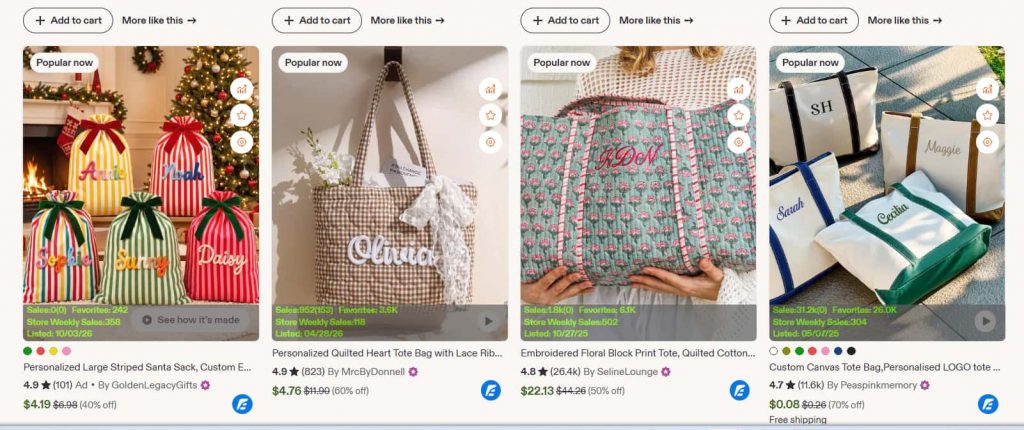
If you want to improve the efficiency of product research, you can use some Etsy SEO tools, such as Ehunt. EHunt can support this research through its Etsy Product Database. It help sellers explore products, review sales, revenue, favorites and other data. Its Etsy Rank Extension also displays sales and favorites directly on Etsy pages without switching between different pages, making it easier to find profitable products.
Find the Right Etsy Keywords
Keyword research helps you understand the language shoppers use when searching for products. The best keywords describe your item accurately and reflect the intent behind a search.
Start with a seed keyword that describes your product, then expand it into more specific phrases based on material, style, recipient, occasion, personalization, or intended use. For example, a seller offering custom tote bags might investigate terms such as "custom tote bag," "personalized canvas tote," and "bridesmaid tote bag." Each phrase represents a different combination of product features and shopping intent.
When evaluating keywords, consider three factors:
Relevance: Does the phrase accurately describe your product?
Demand: Is there evidence that shoppers search for this type of item?
Competition: How many similar listings are targeting the same audience?
A keyword with substantial demand may also face intense competition. A more specific long-tail keyword may have a smaller audience but attract shoppers with clearer purchasing intentions.
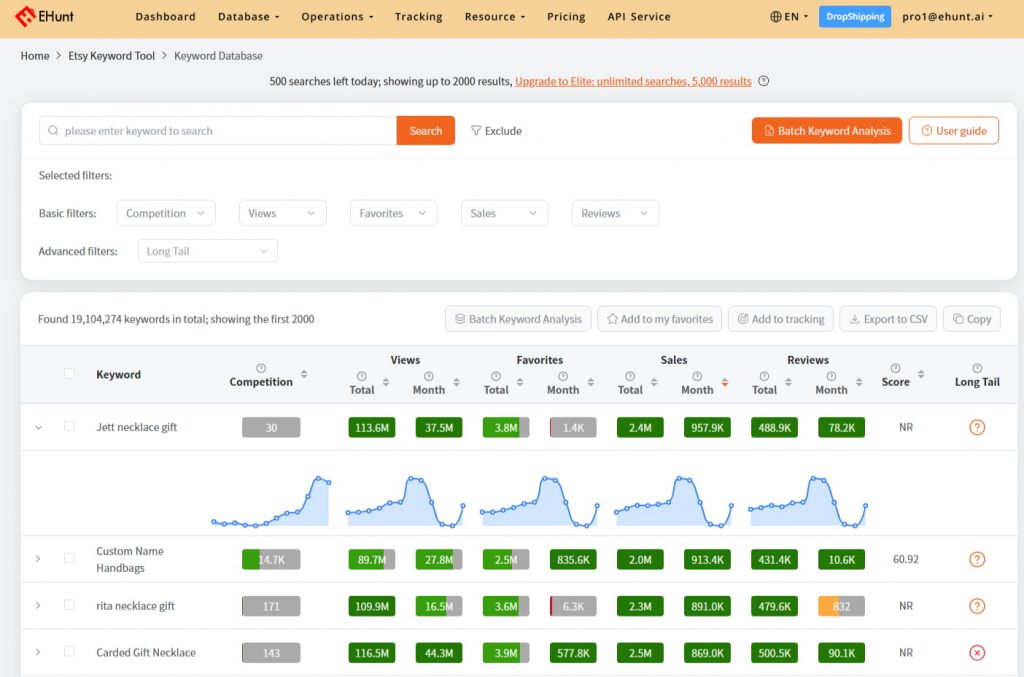
EHunt's Keyword Tool helps sellers explore Etsy keyword ideas, search-related metrics, competition indicators, and longer search phrases. Use these insights to build a shortlist of relevant keywords rather than choosing terms based on search volume alone.
Optimize Etsy Titles and Tags
Your title and tags help Etsy understand what you are selling and which searches may be relevant to your listing.
Write titles that identify the product clearly and naturally incorporate its most important descriptive terms. Put the main product phrase near the beginning when it helps shoppers understand the item quickly. Avoid turning the title into a long sequence of repetitive keywords.
For instance, a title such as "Personalized Canvas Tote Bag, Custom Bridesmaid Gift" communicates the product and its potential use more clearly than a string of loosely connected phrases.
Etsy provides 13 tags for each listing. Use all available tags and choose relevant multiword phrases that describe different aspects of your product. Consider synonyms, occasions, recipients, styles, and specific use cases.
The following table illustrates how a seller might organize keyword ideas for a personalized tote bag.
| Keyword type | Example | Purpose |
| Core product | personalized tote bag | Describes the main item |
| Material or style | canvas tote bag | Highlights a product feature |
| Recipient | gift for bridesmaid | Targets a specific audience |
| Occasion | wedding welcome bag | Connects the product to an event |
| Customization | custom name tote | Emphasizes personalization |
Avoid using every keyword variation in the title or repeating nearly identical tags. Your objective is to cover meaningful search variations while keeping the listing accurate and readable. Etsy also recommends using all 13 tags and diversifying them with relevant phrases.
Choose Relevant Categories and Attributes
Categories and attributes provide additional information about your products and help Etsy match them with appropriate searches.
Select the most specific accurate category available. A product placed in a relevant subcategory may have access to more specific attributes, allowing you to describe its characteristics more precisely. Depending on the product, useful attributes may include color, material, style, size, occasion, or personalization options.
For example, if you sell a personalized necklace, selecting the appropriate jewelry category and accurately completing relevant attributes can help communicate its characteristics more effectively than relying on the title alone.
Do not select unrelated attributes simply because you think they might attract additional traffic. A mismatch between the listing and the shopper's expectations can hurt the buying experience. Review your categories and attributes whenever you introduce new products, change a product's design, or expand your catalog.
Write Clear, Keyword-Relevant Descriptions
A product description should help shoppers understand what they are buying and why the item suits their needs.
Begin with a clear explanation of the product. Include relevant details such as materials, dimensions, colors, personalization options, production times, and care instructions. Organize the information into short paragraphs or bullet points so shoppers can quickly find what matters to them.
Keywords can appear naturally in the description, but avoid repeating the same phrase unnecessarily. Write for people first, making sure the information is accurate and consistent with the title, photos, and product specifications.
For example, a description for a personalized tote bag could explain its material, available name or text customization, intended uses, and suitability as a bridesmaid gift.
Descriptions also help manage expectations. If a product is made to order, explain the process. If colors may look slightly different across screens, communicate that where appropriate. Clear information can reduce confusion and help shoppers decide whether the product meets their requirements.
Improve Listing Photos and Conversion Potential
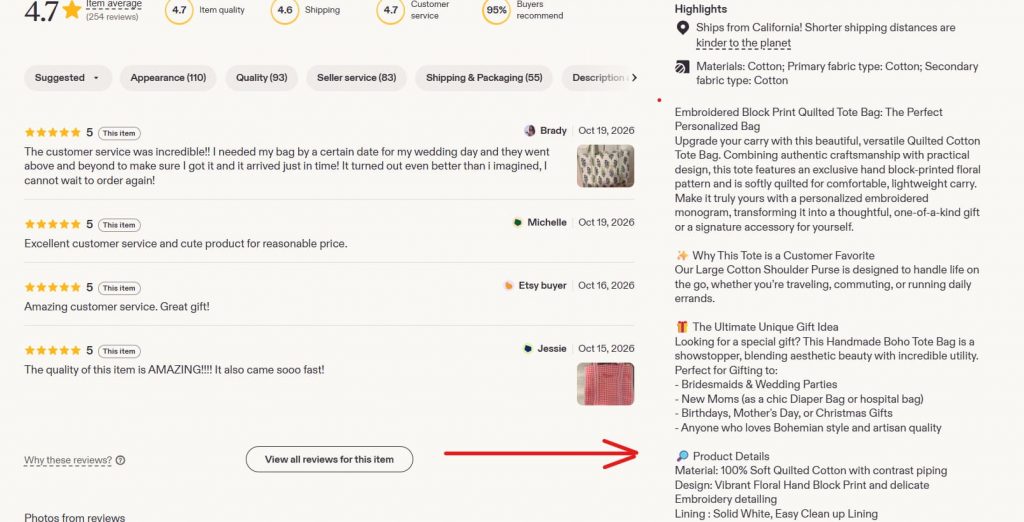
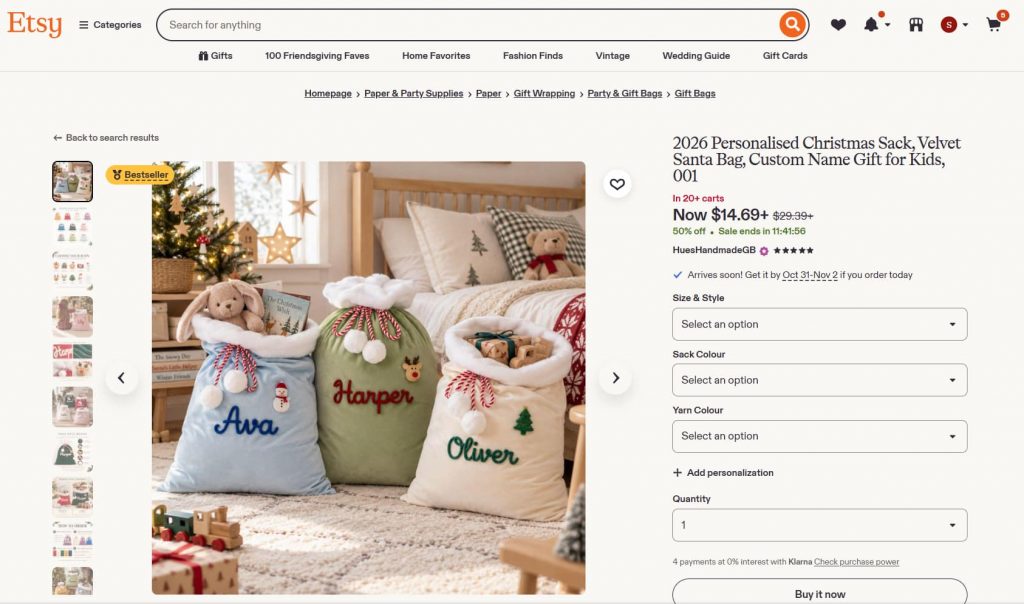
Product photos play an important role in helping shoppers evaluate your offer. Your first photo acts as the listing thumbnail in search results, so it should communicate the product clearly and make its main selling point easy to understand.
Consider including:
- A clear first image that shows the actual product.
- Additional angles that reveal details and construction.
- Close-up images of materials, textures, or personalization.
- Lifestyle images that demonstrate the product in use.
- Size references or diagrams where dimensions may be difficult to judge.
- Customization examples when buyers can choose different options.
For example, a listing for a personalized mug might show the finished design, a close-up of the printed name, the mug's dimensions, and a lifestyle image featuring the product in a kitchen.
Keep images consistent with the product customers will receive. Avoid visual effects or mockups that misrepresent the item's appearance, size, or materials. You can also use product photography to communicate value. If two similar products compete for attention, a clear image showing a unique design or personalization option may help shoppers understand why one item is worth considering.
Better photos do not automatically guarantee higher rankings or sales. However, they can improve the shopping experience and help turn relevant search exposure into meaningful engagement.
How to Measure and Improve Etsy SEO Performance?
Etsy SEO optimization is an ongoing process. After updating a listing, review its performance to understand whether your changes are helping and where further improvements may be needed.
Track Impressions, Clicks, and Sales
Start with Etsy Shop Stats and the search visibility information available in Shop Manager. Review the search terms shoppers use to find your products and look for patterns in traffic and sales.
Different metrics can point to different problems.
| Observed result | Possible explanation | What to investigate |
| Few impressions | Limited search matching or demand | Keyword relevance, categories, and attributes |
| Impressions but few clicks | The listing may not stand out | Title clarity, first photo, and displayed price |
| Clicks but few sales | The offer may not meet expectations | Product details, price, shipping, and trust signals |
| Sales from specific search terms | Stronger alignment with buyer intent | Related keywords and similar product opportunities |
These are diagnostic clues, not definitive explanations. Seasonality, inventory availability, price changes, and other factors can also influence results. Whenever possible, compare performance over a consistent period and consider the context of your niche. A seasonal product may behave differently before, during, and after its peak selling period.
Refresh Underperforming Listings
Once you identify a potential issue, make targeted changes rather than rewriting everything at once.
Review your listings regularly and look for patterns in their performance over time. Compare results before and after each update to understand whether your changes are making a difference. You can also revisit seasonal keywords, update outdated product information, and adjust your listings as customer preferences change.
Change one important element at a time when practical, then allow enough time and traffic to evaluate the result. Making multiple major changes simultaneously can make it harder to understand which adjustment mattered.
Avoid changing successful listings without a clear reason. If a listing already attracts relevant shoppers and generates sales, preserve the elements that appear to be working while testing improvements carefully.
Monitor Competitors and Emerging Trends
Competitor research can help you identify changes in shopper preferences and discover opportunities that your current listings may be missing.
Review successful shops in your niche, paying attention to their product ranges, pricing, presentation, personalization options, and keyword themes. Look for recurring customer needs or underserved product variations rather than copying another seller's listing.
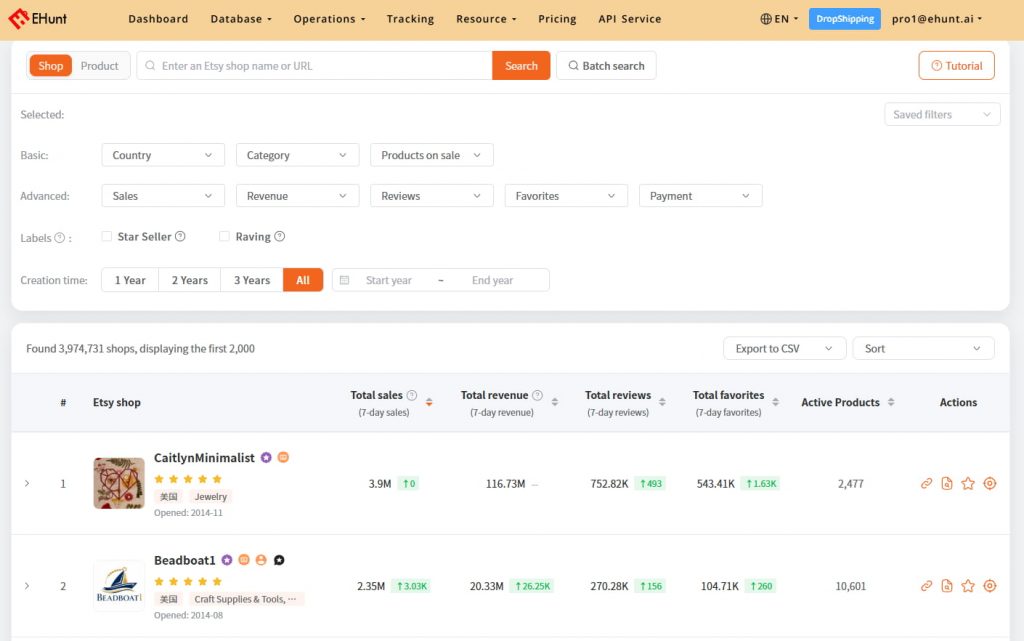
EHunt's Shop Database can help you examine competing shops and products using available sales, favorites, and shop metrics. You can use these observations to compare product performance and generate ideas for your own research.
Trend monitoring is particularly useful for seasonal products. If you sell holiday gifts, for example, investigate relevant search terms and product categories before demand peaks. Build enough time into your schedule to prepare inventory, improve listings, and publish seasonal products before shoppers begin searching in greater numbers.
Competitor data should inform your decisions, not replace them. A popular listing may benefit from brand recognition, customer loyalty, or other advantages that a new seller cannot immediately reproduce.
Common Etsy SEO Optimization Mistakes to Avoid
Even a well-designed SEO strategy can lose effectiveness when sellers focus on the wrong priorities. Avoid these common mistakes.
- Skipping keyword research. Choosing keywords based only on intuition can lead to listings that do not match the language shoppers use. Research demand, competition, and relevance before finalizing your keywords.
- Targeting overly broad terms. Broad keywords may attract a wide range of searches but can make it harder to reach shoppers looking for your specific product. Use relevant long-tail phrases to describe distinctive features and occasions.
- Stuffing keywords into titles and tags. Repetition does not make a listing more useful. Write clear titles and diversify tags with meaningful variations rather than adding unrelated or nearly identical phrases.
- Ignoring categories and attributes. These fields help describe your product and support search matching. Complete every relevant field accurately instead of relying entirely on keywords.
- Neglecting photos and product information. Search visibility has limited value if shoppers cannot understand the product, judge its quality, or find essential purchasing details.
- Making changes without reviewing data. Constantly editing listings without evaluating results can make it difficult to learn what works. Use performance data to identify problems, make focused adjustments, and assess the outcome.
FAQ
How Do I Improve My Etsy SEO?
Start by researching relevant keywords and identifying the search terms most closely related to your products. Optimize your titles and tags, choose accurate categories and attributes, write clear descriptions, and use compelling product photos. Then review Etsy Shop Stats to identify listings that need attention. Focus on one improvement at a time and evaluate the results rather than expecting immediate changes in rankings or sales.
How Long Does Etsy SEO Take to Work?
Once an Etsy listing is updated and reindexed, its SEO will begin to impact search visibility. Changes may take time to produce meaningful performance data, and outcomes vary by product, competition, demand, and listing history. Newly published listings may also behave differently from established ones. Monitor your search visibility, traffic, and sales over a consistent period, and avoid making frequent changes before you have enough information to evaluate their impact.
Should I Update Etsy SEO Keywords Regularly?
Yes, reviewing your Etsy SEO keywords regularly can help you keep your listings relevant as shopper interests and market trends change. However, you don't need to update keywords on a fixed schedule or change them simply for the sake of it. Review your shop's search terms and listing performance, look for new relevant keyword opportunities, and make targeted adjustments when the data suggests a need for improvement.
Can I Use the Same Keywords for Multiple Etsy Listings?
You can use the same keyword when it accurately describes multiple products, but avoid giving every listing an identical keyword strategy. Different products may appeal to different audiences or serve different occasions. For example, similar tote bags might target personalized gifts, wedding favors, or everyday shopping. Use relevant variations to communicate each listing's distinctive features.
Conclusion
Etsy SEO optimization is an ongoing process that combines keyword research, listing improvements, and performance analysis. To improve your opportunities for search visibility, begin with products that meet a clear customer need, choose relevant keywords, optimize titles and tags, complete categories and attributes, and provide clear photos and accurate descriptions.
Once your listings are live, use performance data to identify what is working and where improvements may be needed. Research competitors and emerging trends to uncover new opportunities.
Tools such as EHunt can make this process more efficient by helping you research products, explore keyword opportunities, and analyze competing shops. By combining these insights with a consistent optimization routine, you can make more informed decisions.