 EN
EN Etsy Offsite Ads: The Complete Guide for Sellers in 2026
Etsy Offsite Ads are one of the most misunderstood parts of selling on Etsy. Have you ever opened your Etsy payment statement and found a line item called “Offsite Ads fee” — and wondered whether it’s helping your shop or quietly eating into your profits?
If so, you're not alone.
In this guide, you’ll learn exactly how Etsy Offsite Ads work, how the fee affects your real profit margins, why Etsy chooses certain listings to promote, and how to analyze the ad landscape in your niche before spending a single dollar.
Table of Contents
What Are Etsy Offsite Ads?
Etsy Offsite Ads are an advertising program run by Etsy that promotes your listings on external platforms . Instead of paying for clicks, sellers only pay an advertising fee when a shopper clicks an ad and completes a purchase.
You can think of Etsy Offsite Ads as Etsy acting as your advertising partner. Etsy creates the ads, manages placements across multiple platforms, optimizes bidding, and pays for the traffic upfront — so sellers don’t need to invest in advertising before getting results.
This system is different from Etsy Ads (the on-site advertising option). With Etsy Ads, sellers set a daily budget and pay per click, regardless of whether the ad leads to a sale.
In contrast, Etsy Offsite Ads operate on a pay-for-performance model. Etsy covers the advertising cost, and sellers are only charged when a purchase is generated through the ad.
In most cases, the Offsite Ads fee ranges from 12% to 15% of the total order value, depending on your shop’s revenue over the past 12 months.
Etsy Offsite Ads VS Etsy Ads: What’s the Difference?
The difference between Etsy Ads and Etsy Offsite Ads comes down to where the ads appear and how you pay for them.
| Feature | Etsy Offsite Ads | Etsy Ads (On-site) |
| Where ads appear | Google, Facebook, Instagram, Pinterest, Bing | Directly inside Etsy search and product pages |
| Cost model | Pay only when a sale happens | Pay per click (CPC), regardless of sales |
| Fee amount | 12–15% commission on the total order value | Depends on your daily budget and CPC bids |
| Control | Etsy manages placements automatically | You control the daily budget and active listings |
How Do Etsy Offsite Ads Work?
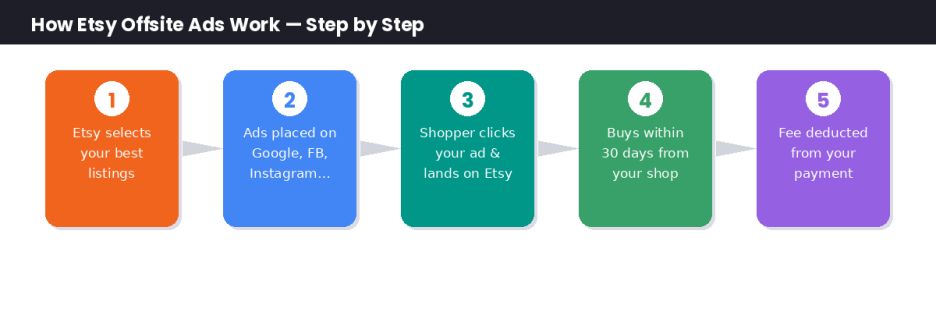
The process runs entirely in the background. Etsy's algorithm continuously evaluates your listings and decides which ones to promote, on which platforms, and to which audiences. Here's how it unfolds from start to finish:
- Etsy's algorithm identifies listings in your shop with strong conversion potential.
- Etsy promotes those listings across external ad networks — Google Shopping, Facebook, Instagram, Pinterest, Bing, and the Google Display Network.
- A shopper sees the ad, clicks through, and lands on your Etsy listing page.
- If they purchase anything from your shop within 30 days of that click, the sale is attributed to the Offsite Ad.
- Etsy deducts the Offsite Ads fee from your payment at the end of the billing cycle.
Which Listings Does Etsy Choose to Promote?
Etsy doesn't disclose its exact selection algorithm, but the listings most likely to be chosen share a few characteristics:
- strong recent sales history,
- high-quality photos, optimized titles and tags,
- competitive pricing, and positive reviews.
In short, Etsy promotes listings it believes are most likely to convert — because every unconverted click costs Etsy money.
This matters strategically: Etsy is financially motivated to promote your best-performing listings, not your newest or most experimental ones. A listing with no sales history is unlikely to be selected, regardless of how good it looks.
Where Do Etsy Offsite Ads Appear? (Platforms Explained)
Etsy's Offsite Ads run across a broad network of plaforms:
- Google Shopping
- Google Display Network
- Facebook and Instagram
- Bing
The platform mix varies by listing category, audience behavior, and Etsy's internal optimization. You won't know which platform drove a specific sale — Etsy doesn't report this breakdown to sellers.
The 30-Day Attribution Window: What It Really Means
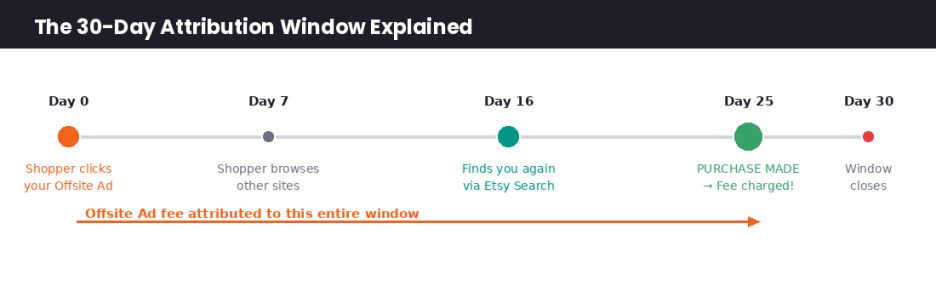
When a shopper clicks an Offsite Ad, any purchase from your shop within the next 30 days is attributed to that ad — even if they returned through organic search, a direct link, or a different device.
A buyer could click your Google Shopping ad on Monday, find you again through Etsy search three weeks later, and you'd still pay the fee on that sale.
Etsy Offsite Ads Fee: How Much Will You Pay?
The fee is tiered based on your shop's revenue over the past 365 days:
| Annual Revenue | Fee | Can You Opt Out |
| Under $10,000 | 15% per sale | yes |
| $10,000 or more | 12% per sale | no |
The fee applies to item price plus shipping, but excludes sales tax. Once you cross $10,000, the 12% rate locks in permanently.
Are Etsy Offsite Ads Profitable?
The fee doesn't exist in isolation. Stacked on top of Etsy's listing fee, transaction fee, and payment processing, you can be looking at roughly 25% of order value going to Etsy on an Offsite Ad sale.
| Gross Margin | After Base Fees | After 15% | After 12% | Verdict |
| 50% | ~40% | ~25% | ~28% | ✅ Healthy |
| 35% | ~25% | ~10% | ~13% | ⚠️ Tight |
| 20% | ~10% | ~-5% | ~-2% | ❌ Loss risk |
| 15% | ~5% | ~-10% | ~-7% | ❌ Loss |
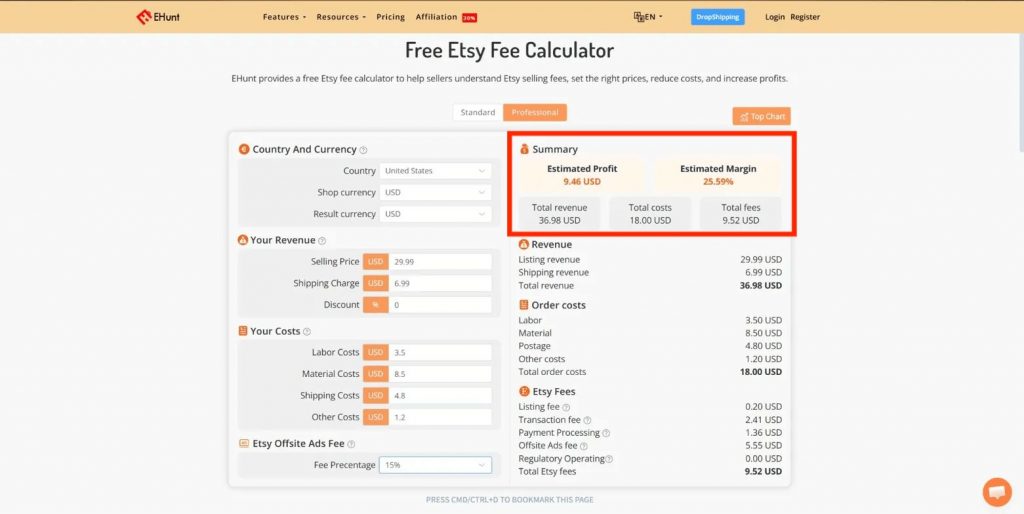
Not sure where your shop lands on this table? EHunt's free Etsy fee calculator lets you plug in your actual selling price, costs, and shipping to see exactly what an Offsite Ad sale leaves in your pocket.
How to Turn Off Etsy Offsite Ads
It depends on your revenue history.
Under $10,000 in the past 365 days: participation is optional. To opt out:
- Go to your Etsy Shop Manager
- Navigate to Settings > Offsite Ads
- Toggle off the "Participate in Offsite Ads" option
$10,000 or more: you cannot opt out. The 12% fee applies to all qualifying sales going forward.
Pros and Cons of Etsy Offsite Ads
Pros
- Zero upfront risk. You pay nothing unless a sale happens. No budget to drain, no clicks to fund, no campaigns to manage.
- Access to premium ad channels. Google Shopping, Instagram, Pinterest, Bing — these are expensive and complex channels for independent sellers to run ads on. Offsite Ads gives you presence there without the overhead.
- Etsy absorbs the advertising risk. Every unconverted click costs Etsy money, not you. That means Etsy is financially motivated to optimize your ads well.
- New customer acquisition. Offsite Ads reach buyers who weren't already on Etsy — people who might never have found your shop through organic search.
- Lower fee for high-volume shops. At 12%, the rate is competitive with standard marketplace fees and far below the cost of self-managed paid advertising at scale.
Cons
- No control over which listings are promoted. You can't exclude items with thin margins, experimental products, or listings you'd rather not advertise externally.
- The 30-day attribution window can feel unfair. Sales that would have happened organically still trigger the fee if there was a prior ad click within the window.
- Mandatory for larger shops — with no exceptions. Once you cross $10,000 in revenue, you're in permanently, regardless of how your margins change.
- No performance visibility. Etsy doesn't tell you which platform drove which sale, what your click-through rates were, or how many impressions your listings received. You're paying a fee without knowing what you're paying for. EHunt's Ad Analysis tool helps close this gap by showing you the external ads that successful Etsy sellers are actually running on TikTok, Instagram, Pinterest, Facebook, and YouTube — so you can study which products they're investing in and what creative strategies are working right now.
- Fees compound. Stacked on top of Etsy's existing fees, the Offsite Ads charge can bring total Etsy costs close to 25% of revenue for lower-margin sellers.
How to Get Your Listings Chosen for Offsite Ads
You can't manually submit listings for Etsy Offsite Ads. Etsy's algorithm automatically promotes listings it believes will convert — so the goal is simple: make your listings strong enough to qualify.
Build a Sales History First
Listings with proven sales performance are more likely to be promoted. A brand-new listing gives Etsy's algorithm little evidence that it will convert.
Focus on generating early traction through Etsy Ads, promotions, or organic search. Once a listing shows consistent sales, it becomes a stronger candidate for Offsite Ads.
Use EHunt's Product Research to Find What's Already Converting
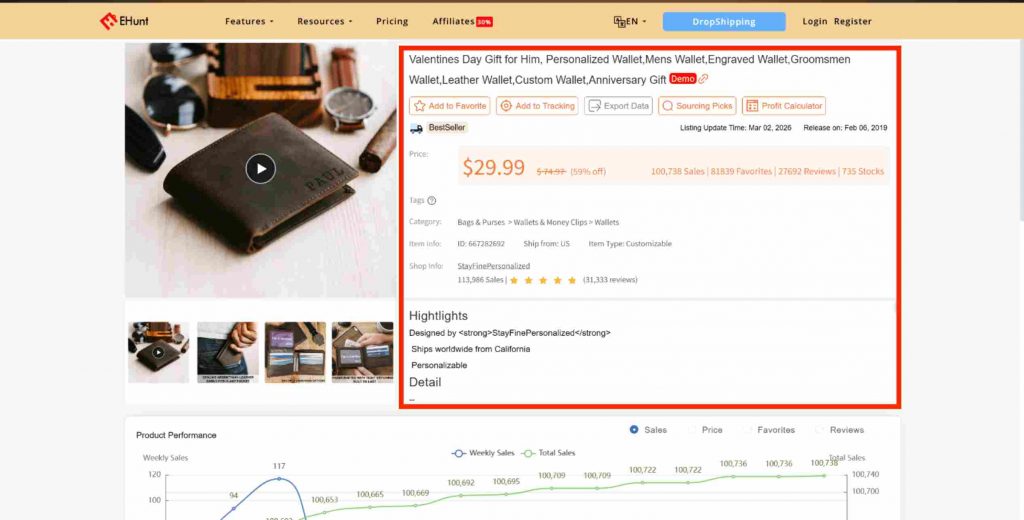
Before launching a new product, analyze what's already selling in your category. EHunt's product research tool surfaces top-performing listings and highlights the patterns — price points, styles, materials, keyword structures — that define high-converting products in your niche.
Optimize for Keywords Buyers Actually Search
Think about how buyers search on Google, not just Etsy. A title like "personalized leather wallet men gift" signals far more search intent than "brown wallet." Use EHunt's keyword research tool to find high-intent terms before you write your listing.
Invest in Photography That Converts
Offsite Ads appear on visual platforms like Instagram, Pinterest, and the Google Display Network. Your main listing image needs to stop the scroll. Strong lighting, clean backgrounds, and lifestyle photography consistently outperform simple product shots. Higher conversion rates signal that the listing is worth promoting.
Price Competitively — Without Killing Your Margin
If your price sits significantly above market rate, conversion drops and your listing gets deprioritized. Use product research to benchmark pricing in your category, then find the point that's competitive enough to convert while still covering the Offsite Ads fee.
What's Actually Working in Offsite Ads Right Now
Etsy gives sellers almost no visibility into how Offsite Ads perform. But the broader ad landscape in your niche is completely visible — if you know where to look.
Every day, sellers promote Etsy listings across TikTok, Instagram, Pinterest, Facebook, and YouTube. Whether those are Etsy's own Offsite Ads or self-funded campaigns doesn't matter. What matters is the signal: a campaign still running weeks later is almost certainly profitable. Sellers don't keep paying for ads that lose money.
EHunt's Ad Analysis tool collects this live data across platforms so you can read those signals quickly and systematically.
The Signal Hidden Inside Active Ad Campaigns
EHunt's ad library tracks active and historical campaigns from Etsy sellers across TikTok, Instagram, Pinterest, Facebook, and YouTube. Filter by product category, sort by estimated impressions or engagement, and see which listings are attracting the most ad activity in your niche.
When an ad has been running 30+ days with strong engagement, it's usually a sign the product converts. The seller has tested it with real audiences — and keeps spending because it performs.
That insight helps when deciding:
- which products to develop
- which price points to test
- which seasonal opportunities to pursue
Categories with very little active ad spend may signal weak external demand — useful to know before investing in a new product line.
Beyond identifying which products are performing, EHunt also lets you examine how they're being promoted.
Study Creative Patterns Before You Shoot a Single Photo
Analyze the actual ad creative across your niche:
- headline copy
- visual format (image vs short video)
- emotional tone
- call-to-action style
Patterns appear quickly. Some niches favor lifestyle photography with emotional copy, while others convert better with clean product shots and price-forward messaging. Some respond to urgency framing like "limited edition." Others do better with identity-driven copy like "made for people who…"
Understand these patterns before your next shoot, and you're working from proven signals — not guesswork.
Pro tip
Open EHunt's Ad Analysis, filter by your exact product category, and sort by "Last 7 Days" or "Estimated Impressions." Look at the top 10 results:
- Which products are getting consistent ad spend?
- What do their visuals and copy have in common?
You've just done the market research most Etsy sellers skip — in under five minutes.
FAQs
Best Etsy Offsite Ads List
Products that perform best in Etsy Offsite Ads typically share three characteristics: strong visual appeal, broad gift appeal, and healthy profit margins (typically above 30%) to absorb the advertising fee.
Categories that consistently do well include:
- Personalized gifts (jewelry, home decor, accessories)
- Wedding and event items
- Print-on-demand products with strong lifestyle photography
- Seasonal and holiday items with clear gifting intent
Lower-margin items, highly niche handmade products, and some digital downloads tend to underperform — the 15% fee can quickly erode already thin margins.
Are Etsy Offsite Ads worth it for small shops?
For shops with gross margins above 30%, Offsite Ads are generally worth participating in. The performance-based model means you only pay when Etsy's advertising actually delivers a sale — a lower-risk proposition than paying per click. For shops with margins below 20%, the 15% fee can push individual sales into unprofitable territory. If you're in that range, opt out while you improve margins, then re-evaluate.
Can multiple orders be attributed to one ad click?
Yes. If a buyer clicks your Offsite Ad and makes three separate purchases from your shop within the 30-day attribution window, all three orders carry the Offsite Ads fee. The attribution is tied to the click, not to the first purchase.
What if a buyer clicks my ad but buys someone else's product?
You pay nothing. The Offsite Ads fee only applies to purchases made from your shop. If a buyer clicks through to your listing but ends up buying from a different seller, there's no charge to you.
Do Offsite Ads affect my Etsy search ranking?
Not directly. Offsite Ads operate independently of Etsy's organic search algorithm. However, the sales generated by Offsite Ads contribute to your shop's overall sales history, which is one of the factors Etsy considers when ranking listings organically. Strong Offsite Ads performance can indirectly improve your organic visibility over time.
Final Verdict
Etsy Offsite Ads can drive real sales — but the platform gives sellers very little visibility into what's actually working.
EHunt fills that gap by showing search trends, competitor ads, and the products already attracting external traffic in your niche.
When you can see what works, Offsite Ads become a strategy — not a gamble.